How to Level a Shipping Container After Delivery: The Ultimate Step-by-Step Guide
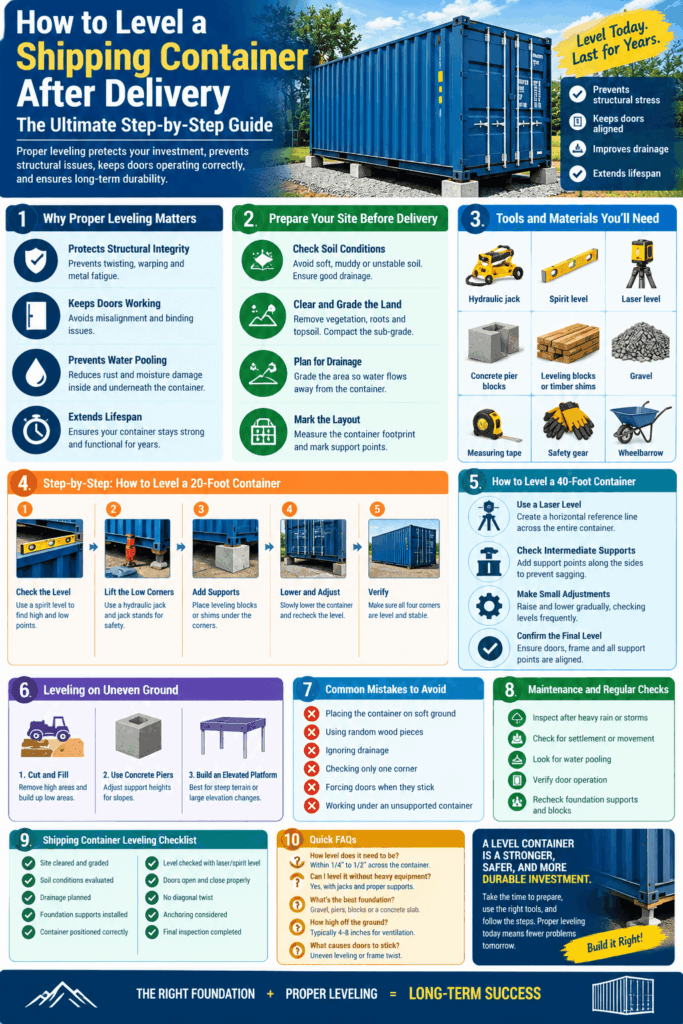
Learning how to level a shipping container after delivery is essential for protecting the container’s structural integrity, keeping the doors operating correctly, improving drainage, and creating a stable foundation for long-term use. Whether we are installing a 20-foot shipping container, positioning a 40-foot shipping container, preparing a storage unit, or developing a shipping container home, proper leveling should be completed immediately after delivery.
A shipping container is engineered around a strong structural frame, with the corner posts and corner castings carrying much of the container’s load. When those support points sit unevenly on unstable or sloped ground, the frame can experience unwanted stress. The result can include sticking doors, distorted openings, uneven floors, foundation settlement, and moisture-related problems.
The good news is that a systematic shipping container leveling process can solve many of these problems. By preparing the site correctly, checking elevations, using appropriate foundation supports, and making controlled adjustments, we can establish a stable and level installation.
Why Proper Shipping Container Leveling Matters
Proper leveling is not simply an aesthetic improvement. It directly affects how the entire container performs after delivery.
Shipping containers are designed to withstand demanding transportation and stacking conditions, but their structural strength depends heavily on their frame geometry. When one corner is significantly higher or lower than another, the container can become distorted.
1. Preventing Door Problems
One of the clearest signs of an improperly leveled container is door binding. Cargo doors are designed to operate within a relatively square frame. When the container twists diagonally, the doors may become difficult to open, close, or seal.
If the doors remain difficult to operate after installation, we should inspect the container for diagonal distortion rather than simply forcing the doors shut.
2. Reducing Structural Stress
An uneven foundation can place unnecessary stress on the corrugated steel walls, corner posts, welds, and frame. Over time, continued distortion may contribute to premature wear.
3. Improving Drainage
Standing water around the container increases exposure to moisture. Proper elevation and site drainage help reduce the amount of water collecting around the bottom of the steel structure.
4. Protecting the Container Investment
A shipping container can provide many years of service when installed on an appropriate foundation. Proper leveling helps us establish the stable starting point required for storage, workshops, offices, agricultural applications, and other uses.
How to Prepare the Site Before the Shipping Container Arrives
The easiest time to solve a leveling problem is before the container is delivered. Once a heavy steel container has been placed on the property, correcting an unsuitable foundation becomes substantially more difficult.
Inspect the Soil
We should first examine the condition of the ground where the container will sit.
Different soils behave differently under heavy loads:
- Clay soil can retain moisture and move as moisture conditions change.
- Loose sandy soil can erode or shift.
- Rocky ground can provide excellent stability but may require more preparation and grading.
- Loose topsoil should generally not be treated as a finished bearing surface.
The source material emphasizes removing vegetation and topsoil until we reach stable sub-grade material, followed by adequate compaction.
Establish Proper Drainage
The container site should not become a low point where rainwater collects. We should plan the surrounding grade so water moves away from the foundation rather than toward it.
A properly prepared gravel base can also assist with drainage while providing a more stable surface for foundation supports.
Clear Vegetation and Organic Material
Before installation, we should remove:
- Grass
- Roots
- Brush
- Organic debris
- Loose topsoil
- Other unstable surface materials
The remaining sub-grade should then be compacted thoroughly.

Shipping Container Leveling Tools and Equipment
The equipment required depends on the size of the container, the amount of correction needed, and the foundation design.
Common equipment includes:
- Hydraulic bottle jacks
- Shipping container leveling jacks
- Laser levels
- Long spirit levels
- Measuring tapes
- Marking paint
- Shipping container leveling blocks
- Concrete pier blocks
- Pressure-treated timbers
- Crushed gravel
- Concrete pads or piers
- Appropriate personal protective equipment
For a 40-foot container, a laser level can make it substantially easier to establish a consistent elevation across the entire installation.
Safety Comes First
A shipping container is extremely heavy. We should never place any part of our body beneath a container that is supported only by a hydraulic jack.
When lifting is necessary, the container must be properly supported with equipment appropriate for the load and the work should be performed using safe lifting procedures. For substantial corrections, difficult terrain, permanent structures, or situations requiring significant lifting, professional assistance is the safer choice.
How to Level a 20-Foot Shipping Container
A 20-foot shipping container has a shorter span than a 40-foot unit, but it still requires accurate leveling.
Step 1: Inspect the Container Immediately After Delivery
Once the container has been placed on the prepared foundation, we should inspect:
- The four corners
- The side rails
- The door frame
- The floor
- The foundation supports
- The surrounding grade
Use a spirit level or laser level to identify high and low areas.
Step 2: Identify the Low Corners
We should determine which corner or corners require elevation adjustment. It is important to avoid making random changes because lifting one corner can affect the geometry of the entire container.
Step 3: Raise the Container Carefully
Where lifting is required, an appropriately rated hydraulic lifting system can be used near the structural corner support area. The container should be raised gradually rather than suddenly.
The source specifically recommends systematic corner-by-corner adjustment and warns against going underneath an unsupported container.
Step 4: Install Stable Supports
Once the desired elevation is established, suitable shipping container leveling blocks, concrete supports, or other engineered foundation materials can be positioned beneath the appropriate structural support points.
The supports must sit on a stable base rather than directly on loose mud or uncompacted soil.
Step 5: Recheck the Level
After lowering the container onto the supports, we should check the level again.
A container that appears level before loading can settle differently after its foundation or soil begins carrying the full load, so verification is important.
How to Level a 40-Foot Shipping Container
Learning how to level a 40-foot shipping container requires additional attention because the longer structure can magnify relatively small differences in elevation.
A 40ft shipping container may require additional support depending on the foundation design, soil conditions, intended use, and local requirements.
Establish a Laser-Level Reference
A laser level provides a horizontal reference across the container installation area. We can use that reference to compare the elevations of the corner supports and other planned foundation points.
The source recommends establishing a baseline with a laser level and progressively adjusting the support points for longer containers.
Check Intermediate Support Locations
Where the foundation design calls for intermediate supports, these should be checked against the same elevation reference.
We should avoid creating a situation where the four corners appear level while an intermediate section is inadequately supported.
Make Small, Controlled Adjustments
Rather than making large elevation changes at once, we should make controlled adjustments and repeatedly check the container.
This approach helps us avoid introducing unnecessary twist into the frame.
Best Shipping Container Leveling Blocks and Foundation Supports
The quality of the support system is just as important as the leveling process itself.
Suitable options may include:
Concrete Pier Blocks
Concrete supports provide a durable bearing surface and are frequently used beneath the structural support areas of containers.
Crushed Gravel Foundations
A properly compacted gravel pad can provide drainage and a stable base for suitable support blocks or piers.
Pressure-Treated Timbers
Heavy treated timbers can be used in appropriate foundation designs, provided they are adequately supported and protected against ground-related deterioration.
Concrete Slabs
A properly designed concrete slab provides a continuous foundation and can be appropriate for permanent installations, workshops, offices, and container-based living spaces.
Adjustable Leveling Feet
Specialized shipping container leveling feet can provide fine elevation adjustments in systems designed for that purpose. Threaded adjustment mechanisms allow the height to be fine-tuned without repeatedly repositioning conventional shims.
How to Level a Shipping Container on Uneven Ground
A sloped property does not necessarily prevent us from installing a shipping container. However, the foundation must be designed to create a stable, level support plane.
Option 1: Cut and Fill
We can modify the site by cutting down the high areas and building up the low areas. This approach may work well for moderate slopes when adequate soil compaction and drainage can be achieved.
Option 2: Concrete Piers
For more significant elevation changes, properly designed concrete piers can create individual support points at different heights while maintaining a level container.
Option 3: Elevated Foundation Systems
On steeper terrain, an engineered elevated foundation may be more appropriate than attempting to create a simple flat pad.
The source recommends evaluating whether to use cut-and-fill techniques or elevated supports and emphasizes establishing the high side as a reference before building up the lower side.
How to Level a Shipping Container on Dirt
When we need to install a container on dirt, we should avoid placing the corner castings directly onto soft or wet soil.
A better installation sequence is:
- Remove vegetation and unstable topsoil.
- Establish the desired container footprint.
- Grade the area.
- Compact the sub-grade.
- Install a suitable crushed gravel base.
- Compact the gravel.
- Position appropriate support blocks, pads, or piers.
- Check elevations with a laser or spirit level.
- Position the container.
- Verify the level and door operation.
The uploaded source similarly recommends compacting the soil, creating a crushed gravel drainage layer, and using suitable foundation pads or concrete supports beneath the container’s structural support areas.
How to Tell If a Shipping Container Is Level
We should use more than one test.
Use a Spirit Level
Place a sufficiently long spirit level along the container’s structural rails and across relevant areas of the frame.
Use a Laser Level
A laser level provides a more comprehensive reference, particularly for a 40-foot container or installations involving multiple support points.
Check the Doors
The doors provide a useful practical indication of frame alignment. If the doors operate smoothly and do not bind, this is a positive sign.
However, door operation should not be the only measurement used to determine whether the container is correctly installed.
Check the Diagonals
If a container appears level but the doors still bind, we should investigate possible racking or diagonal twist. Measuring the diagonals can help identify whether the frame has become distorted.
What Causes a Shipping Container to Become Unlevel After Delivery?
Even a correctly leveled container can move later if its foundation is inadequate.
Common causes include:
- Poorly compacted soil
- Heavy rainfall
- Drainage problems
- Foundation washout
- Soft clay
- Erosion
- Inadequate support area
- Uneven loading
- Settlement beneath individual supports
- Improper foundation construction
This is why container installation should be treated as an ongoing foundation-management issue rather than a one-time leveling task.
How to Prevent Shipping Container Leveling Blocks From Sinking
If foundation blocks begin sinking, the problem usually starts underneath them.
We should inspect the sub-grade rather than simply adding additional shims.
A stronger approach can include:
- Raising the container using an appropriate professional lifting procedure.
- Removing soft or unstable material.
- Compacting the underlying soil.
- Installing geotextile fabric where appropriate.
- Adding a properly graded crushed-rock base.
- Compacting the base thoroughly.
- Reinstalling suitable support pads.
- Rechecking the container elevation.
The source specifically identifies inadequate sub-grade preparation as a major reason leveling blocks sink and recommends rebuilding the support base when necessary.
Shipping Container Load Distribution After Leveling
Leveling the container correctly is only part of maintaining a stable installation.
Once the container is loaded, we should distribute weight sensibly.
Heavy equipment, dense inventory, machinery, and other concentrated loads should not be placed carelessly against a single wall or at one end of the container.
Instead, we should:
- Keep extremely heavy items low.
- Distribute concentrated loads where appropriate.
- Avoid unnecessary weight concentration at one corner.
- Inspect the foundation after severe rainfall.
- Watch for settlement around individual support points.
The source specifically recommends placing heavy materials toward the bottom and center and inspecting foundation pads after heavy rainfall.
Leveling a Shipping Container for a Home or Office
A storage container and a shipping container home have different requirements.
Once a container becomes a habitable structure, leveling becomes particularly important because the building may contain:
- Plumbing
- Electrical systems
- Interior walls
- Flooring
- Windows
- Doors
- Cabinets
- Appliances
- Insulation
- Finished ceilings
Even small movements can become more noticeable after the interior has been completed.
For permanent structures, we should evaluate the foundation requirements, local building regulations, soil conditions, drainage, climate, and structural loads before construction begins.
Concrete piers, strip foundations, slabs, and other engineered systems may be appropriate depending on the project. The source identifies both pier and strip foundation approaches for container homes and offices.
Common Shipping Container Leveling Mistakes to Avoid
Placing a Container Directly on Soft Ground
Soft soil can settle under the container’s concentrated support points.
Using Random Pieces of Wood
Improvised materials may deteriorate, split, shift, or compress. Foundation materials should be selected for the expected load and environmental conditions.
Ignoring Drainage
A perfectly level container can still experience foundation problems if rainwater repeatedly washes away the supporting material.
Checking Only One Corner
All relevant support points need to be considered.
Ignoring Door Alignment
Sticking doors can be an important warning sign of frame distortion.
Making Large Jacking Adjustments
Large, sudden changes can introduce additional stress. Adjustments should be controlled and systematically checked.
Working Under an Unsupported Container
This is one of the most serious hazards. We should never enter the space beneath a container that is supported only by a jack.
How Often Should We Check a Leveled Shipping Container?
A newly installed container should be inspected periodically, particularly after:
- Heavy rain
- Flooding
- Snow or freezing conditions
- Significant ground movement
- Major changes in internal loading
- Construction work around the foundation
We should look for:
- New door binding
- Visible gaps beneath supports
- Leaning or settlement
- Cracked concrete
- Washed-out gravel
- Standing water
- Corrosion near the bottom frame
- Movement of foundation blocks
Early detection allows relatively small foundation problems to be corrected before they become major structural or operational issues.
How High Should a Shipping Container Be Off the Ground?
The source indicates that containers are commonly elevated several inches above the surrounding ground to provide clearance and ventilation beneath the structure.
The exact elevation should depend on the foundation system, drainage requirements, terrain, climate, access requirements, and applicable construction standards.
The goal is to create adequate separation from standing water while maintaining a stable support system.
How Much Does It Cost to Level a Shipping Container?
The cost of shipping container leveling depends heavily on the site and foundation design.
A simple installation using existing suitable ground and basic support materials may be relatively inexpensive. More complicated installations can require:
- Excavation
- Gravel
- Concrete
- Reinforcement
- Formwork
- Specialized lifting equipment
- Professional labor
- Engineered foundation systems
- Drainage improvements
The uploaded source notes that simple DIY support materials may cost less than professional concrete foundation work, while more substantial pier or slab installations can cost considerably more.
Rather than choosing a foundation exclusively based on the lowest initial cost, we should consider stability, drainage, durability, accessibility, future use, and maintenance requirements.
Shipping Container Leveling Checklist
Before considering the installation complete, we should verify the following:
- The site has been cleared and graded.
- Unstable topsoil has been removed.
- The sub-grade has been adequately compacted.
- Drainage moves water away from the container.
- The foundation supports are stable.
- All required support points are properly supported.
- The container has been checked from multiple directions.
- The four corners have been evaluated.
- A laser level or spirit level has been used.
- The doors open and close properly.
- No obvious diagonal twist is present.
- The container does not rock or shift.
- The foundation materials are appropriate for the intended load.
- The surrounding area is protected against erosion and washout.
- The foundation is suitable for the container’s intended use.
Frequently Asked Questions About Leveling Shipping Containers
Can We Level a Shipping Container Without Heavy Machinery?
For minor adjustments, suitable hydraulic lifting equipment and appropriate support materials may be sufficient. However, container lifting involves significant weight and risk. We should use equipment correctly rated for the load and obtain professional assistance when the adjustment is substantial or the installation is complex.
How Level Does a Shipping Container Need to Be?
The uploaded source recommends maintaining a very small elevation difference across the container to help preserve proper door operation and frame alignment.
For permanent or habitable installations, the applicable project specifications and local requirements should take precedence.
What Is the Best Foundation for a Shipping Container?
There is no single foundation that is ideal for every property. Gravel pads, concrete piers, slabs, timbers, blocks, and engineered foundations can all have appropriate applications depending on soil, drainage, climate, slope, container size, and intended use.
Do We Need to Level an Empty Shipping Container?
Yes. Leveling should be completed after delivery rather than waiting until the container is fully loaded. An empty container should still be properly supported and aligned.
Why Are Shipping Container Doors Sticking?
Sticking doors can indicate that the container frame has become distorted or that the container is not properly supported. We should check the foundation and investigate possible diagonal racking before forcing the doors.
Can We Put a Shipping Container Directly on Dirt?
We should not simply place a container on loose dirt and assume the ground will remain stable. Proper site preparation, compaction, drainage, and suitable support points are important for a durable installation.
Are Shipping Container Leveling Feet Adjustable?
Some specialized leveling systems use threaded mechanisms that allow controlled height adjustments. Their suitability depends on the specific product and foundation design.
Final Guide to Leveling a Shipping Container After Delivery
A properly leveled shipping container begins with proper site preparation. Before delivery, we should assess the soil, establish drainage, remove unstable material, and create a compacted foundation area.
After delivery, we should inspect the container, establish a reliable elevation reference, identify any low support points, and make controlled adjustments using appropriate equipment. Once the container is level, we should verify the foundation supports, check the doors, inspect for frame distortion, and monitor the installation over time.
For simple storage applications, a properly prepared gravel foundation with suitable support blocks may be adequate. For permanent structures, offices, workshops, and shipping container homes, a more substantial foundation may be necessary.
The most important principle is consistency: stable ground, stable supports, accurate measurements, controlled adjustments, and proper drainage. When these elements are addressed from the beginning, we can significantly reduce the risk of settling, door problems, structural distortion, moisture exposure, and premature foundation failure.
A level shipping container is not simply easier to use. It provides the stable starting point required for a safer, more durable, and more reliable container installation for years to come.